
Your change, given back and kept.
“I have no change.” You know what comes next: a scrap of paper, a handful of sweets, or you leave your shopping on the counter. Kobri replaces the voucher with a balance on your phone — spend it at another shop, or withdraw it in cash.
Kobri operates under the licence of an approved institution — COBAC Regulation R-2019/01. Funds never leave the partner.
Change received
Le Palmier supermarket · 2 s ago
Giving change back costs money
The paper voucher
A debt the shop owes you. Untracked, unfunded. Lost, forgotten, or refused six months later — and the money stays with the shopkeeper.
The sweets
You get your change in biscuits, tissues, chewing gum. You asked for none of it, and you are paying full price for it.
Buying coins
Some shopkeepers buy their coins. They pay, out of their own margin, for the privilege of handing back money that is already yours.
The paper voucher becomes a balance.
becomes
Today A slip of paper that tears, gets lost, and gets refused.
With Kobri A traceable balance, spendable elsewhere, withdrawable in cash. Available immediately
Four hundred and ten francs, end to end
Here is the scene as it actually happens, with the numbers. This is what Kobri solves, and it happens several times a day in every shop.
You leave with your shopping and your 410 FCFA. The shopkeeper did not lose the sale, did not write a voucher, and did not have to buy coins.
| Your shopping | 1,590 FCFA |
|---|---|
| You hand over | 2,000 FCFA |
| Change owed | 410 FCFA |
| What the shopkeeper has in the till | 3 coins |
| Today: a handwritten voucher | to be found again |
| With Kobri: credited to your phone | 410 FCFA |
Three gestures, under five seconds
The shopkeeper shows their QR
They enter what they owe you — 410 FCFA — and a six-digit code appears, valid for three minutes. A printed QR is enough: no till system required.
At the counter · Le Palmier supermarket
To give back410 FCFACode for the customer · 2 min 24 s left
You scan, then type the code
On your own phone, which never leaves your hand. The code works once, for that exact amount. Stolen, it is worthless.
Le Palmier supermarket
Code from the shopkeeper
482915Valid once, for this amount
Your balance is credited
In under five seconds, both parties are notified. Spend it at another Kobri shop, or withdraw it from the app.
2 910FCFA- Le Palmier supermarketChange received · just now+ 410
The phone stays in the customer’s hand. It is the shopkeeper’s code that authorises the operation — not a device changing hands. 5 s to give change back, end to end (A design constraint).
Your balance does not sit idle
Pay at another shop
Scan the shop’s invoice, check the amount, sign with your PIN. Yesterday’s change pays for today’s shopping, somewhere else.
Withdraw it
Request it in the app: the partner microfinance pays it out, and nothing is debited before.
Keep it
It does not expire. Unlike a paper voucher, nobody can tell you six months later that it is no longer valid.
Three balances, three purposes
Your money is not mixed together. Each balance has a clear origin and clear rules — you always know where what you hold came from.
Main
What you pay into your account yourself, and what you withdraw from it. This is your current account.
My change
The change shopkeepers give back to you. It lands here, and you spend it at any Kobri merchant.
Savings
What you put aside: the round-up of a payment to the hundred, what your change holds beyond the hundred. It goes back into your change with your PIN.

Your transactions
- Le Palmier supermarketChange received · today, 14:22
- Alimentation BonanjoPayment · yesterday, 18:05
Against the alternatives
| What you get | Paper voucher | Sweets | Kobri |
|---|---|---|---|
| You get the exact value back | Partly | No | Yes |
| Usable outside that one shop | No | No | Yes |
| Convertible into cash | No | No | Yes |
| Traceable and enforceable | No | No | Yes |
| Cannot be lost or damaged | No | No | Yes |
| Free for you | Yes | No | Yes |
A paper voucher does in theory return the exact value — provided you find it again, return to that specific shop, and it is accepted.
The network drops. Your change does not.
In Cameroon, connectivity is not a given. Receiving your change cannot depend on a signal bar — we designed the service from that starting point.

- Le Palmier supermarketWaiting for the network · Change received offline
- Receiving change works offline, up to 5,000 FCFA
- The operation is queued on your phone and synchronised when the network returns
- No double credit is possible: every operation carries a uniqueness key
- The queue survives an application restart
Paying and withdrawing require a connection: they are outgoing operations and cannot be approved blind. The offline ceiling bounds the risk.
We do not hold your money
Funds stay with a licensed financial institution. Kobri is never the custodian — if we disappeared tomorrow, your balance would not move.
- Double-entry ledger: the sum of all balances is exactly zero
- Tamper-evident log: any alteration breaks the chain and becomes visible
- No operation can ever run twice
- Your PIN only ever protects outgoing operations
The ledger, double-entry
- Your changeSupermarché Le Palmier gives it back
- Store floatThe store pays for it
Sum of all balances
We operate under your licence
Kobri holds no funds and seeks no licence of its own. COBAC Regulation R-2019/01 provides that distributors and sub-distributors operating under the cover of an approved provider do not require their own approval. You are the provider. We are your distributor.
385 licensed microfinance institutions in Cameroon (COBAC list, 31 December 2025). 73.7% of all CEMAC microfinance institutions are Cameroonian (384 out of 521).
You are the provider
You hold the licence, you hold the funds in your segregated account, you remain responsible for the activity. Nothing changes in your regulatory position.
Kobri is your distributor
We operate in your name and on your behalf. We never have access to the funds. The distribution agreement sets out precisely what is entrusted to us.
Merchants are sub-distributors
They operate under your licence. Each engagement triggers your duty to notify COBAC within one month.
- Your customers, your float
- Every Kobri user becomes your customer, with KYC already on file. The float sits in your segregated account — interest-bearing, and shielded from creditors.
- Your COBAC notifications
- Every sub-distributor you engage triggers a one-month notification duty. Kobri assembles the file, tracks the deadline and warns you before it expires.
- Accounts you can verify
- Double-entry ledger, hash-chained audit log. Any tampering is detectable — including tampering done directly in the database.
Stop hunting for coins
No more lost sales, no more paying for coins, and the customer comes back — just like with the voucher, but without the notebook or the arguments.
- No more buying coins out of your margin
- A printed QR is enough — no equipment to install
- Every sale tracked from the app
- No withdrawals to serve: customers withdraw in Kobri
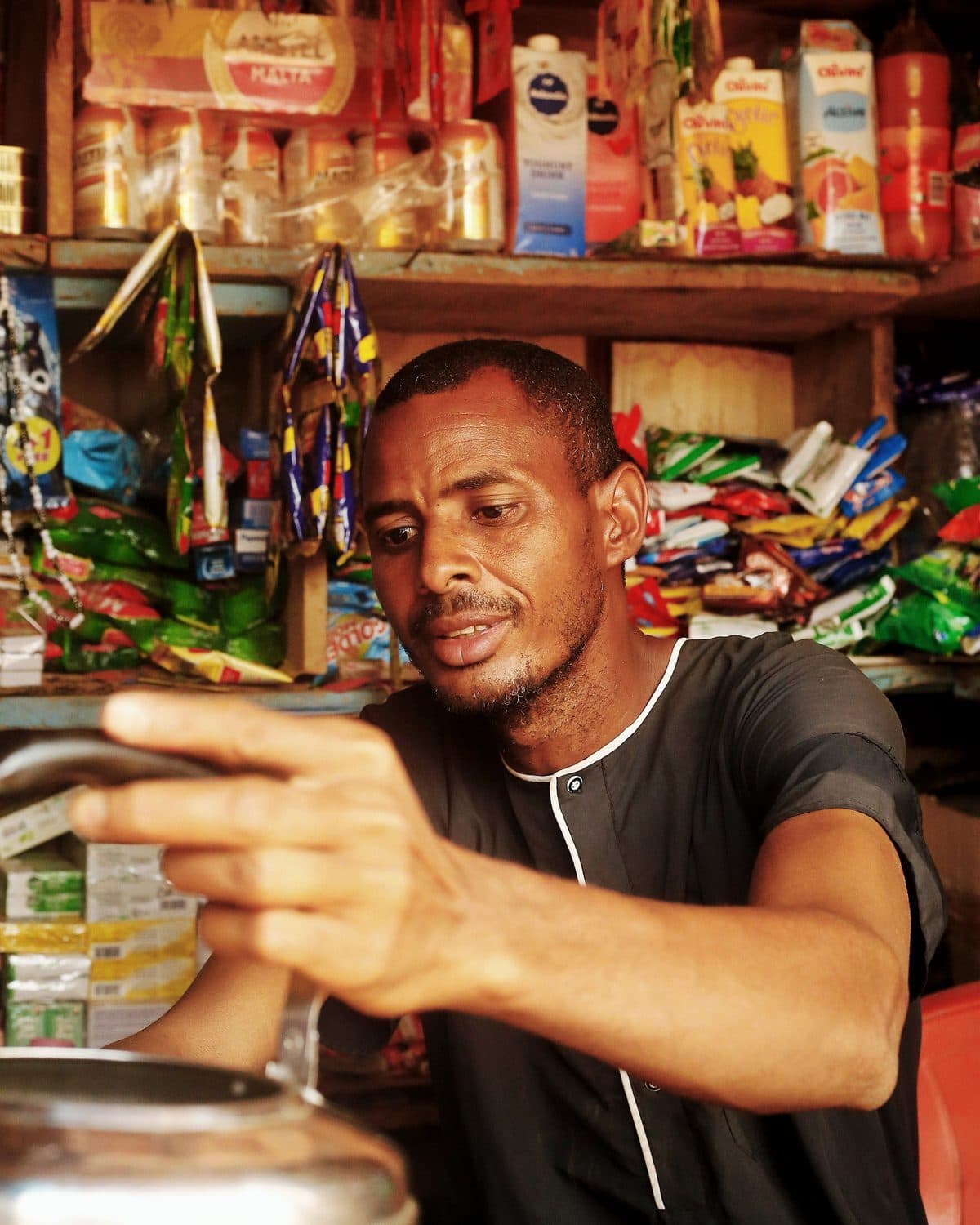
Le Palmier supermarket · demonstration

Change you can withdraw
A balance is only worth something if it can become banknotes. The customer requests a withdrawal in the app, the partner microfinance pays it out, and nothing is debited before. The shopkeeper never hands out cash.
Merchants are sub-distributors of the partner institution, within the meaning of COBAC Regulation R-2019/01. The funds stay with it: it pays out every withdrawal, under its licence.
Coming to your phone
The application is under development. It is not published yet, and we would rather tell you that than show a button leading nowhere. Leave us your number and you will hear from us the day it opens.
- AndroidComing soon
- iPhonePlanned after Android
Get notified at launch
One message, on the day the app opens. Nothing else.
Your contact detail is used solely to notify you of the launch. No advertising, no resale.
- Under 30 MB — it fits on a full phone
- Android 6.0 and above, including entry-level devices
- Runs on less than 2 GB of memory
- Offline mode for receiving change

What we get asked most
Does it cost me anything?
No. Receiving your change is free. It is your money — you should not pay to get it back.
Someone asked for my PIN to give me money. Is that normal?
No, that is fraud. Your PIN only ever moves money out: paying, withdrawing. Never to receive it.
What if I lose my phone?
The device is revoked immediately. Your balance is untouched: it is recorded with the financial institution, not in your phone.
Can my balance expire?
No. It belongs to you and does not evaporate. That is exactly the difference from a voucher forgotten in a pocket.

Let’s talk.
We are looking for one microfinance institution to run the first pilot, and shopkeepers to put it to the test.